IoT · Time-Series ML · Full-Stack
Indoor Environment AI
A self-built indoor-climate automation system — ESP32/Pico W sensors and Shelly smart plugs feed InfluxDB, and an hourly scheduler uses an ML model to decide whether a dehumidifier should run.
Sensors in the rooms, a time-series database on the shelf, and a model that decides when the dehumidifier should run. Indoor Environment AI is a complete closed loop: edge devices collect indoor climate data, InfluxDB stores it, and an hourly scheduler runs an ML regressor whose output is compared against a threshold to switch a Shelly-controlled dehumidifier on or off — no cloud, no manual intervention.
The idea
Stop guessing when to run the dehumidifier.
Indoor humidity swings with the weather, the ventilation (FTX) system and whether a dehumidifier is running. The goal is to predict indoor humidity from sensor history and outdoor weather, then let a scheduler act on that prediction every hour — turning the dehumidifier on only when the model says humidity is heading above a threshold, and off otherwise.
The work splits into three layers:
- Collect — battery-powered edge sensors and smart-plug meters push readings into InfluxDB, either directly or through Telegraf.
- Decide — a FastAPI backend runs an hourly scheduler that loads a trained scikit-learn model, builds lag/periodic features from recent sensor history and compares the model’s output to a per-hour threshold.
- Act — the chosen
on/offaction is sent to the Shelly smart plug that powers the dehumidifier, and the state is recorded.
Architecture
The diagram below shows the full data path: how IoT devices collect readings, how they land in InfluxDB, and how the backend’s scheduler, device manager and ML model service cooperate to control a real appliance — with SQLite holding the configuration and a React dashboard driving it all.
Pico W · MicroPython
temp · humidity · gas resistance"] SHELLY["Shelly Plug S
relay + power meter
powers the dehumidifier"] end INFLUX[("InfluxDB
bucket 'home'
time-series store")] TG["Telegraf
inputs.http · json_v2"] ENV -->|"direct write · every 10 min"| INFLUX SHELLY -->|"/status/0 JSON · 30 min"| TG TG --> INFLUX subgraph be["FastAPI backend"] direction TB DM["DeviceManager
SwitchDevice · SensorDevice"] SCH["DeviceScheduler
hourly asyncio loop"] MLS["MLModelService
pickle / ONNX · cached"] IP["InputProcessor
lags + sin/cos features"] end DM -->|"Flux queries"| INFLUX SCH --> DM SCH --> MLS MLS -->|"build features"| IP DM -->|"device readings"| IP SCH -->|"threshold → on / off"| SHELLY SQLITE[("SQLite
devices · schedules
ml_models · state")] be <--> SQLITE subgraph train["Offline training"] SMHI["SMHI API
outdoor weather"] NB["Jupyter notebook
HistGradientBoosting + SHAP"] end INFLUX -->|"CSV backups"| NB SMHI --> NB NB -->|"joblib dump"| PKL["models/*.pkl"] PKL --> MLS subgraph fe["React dashboard"] UI["Devices · Schedules
ML Models · Status"] end UI <--> be
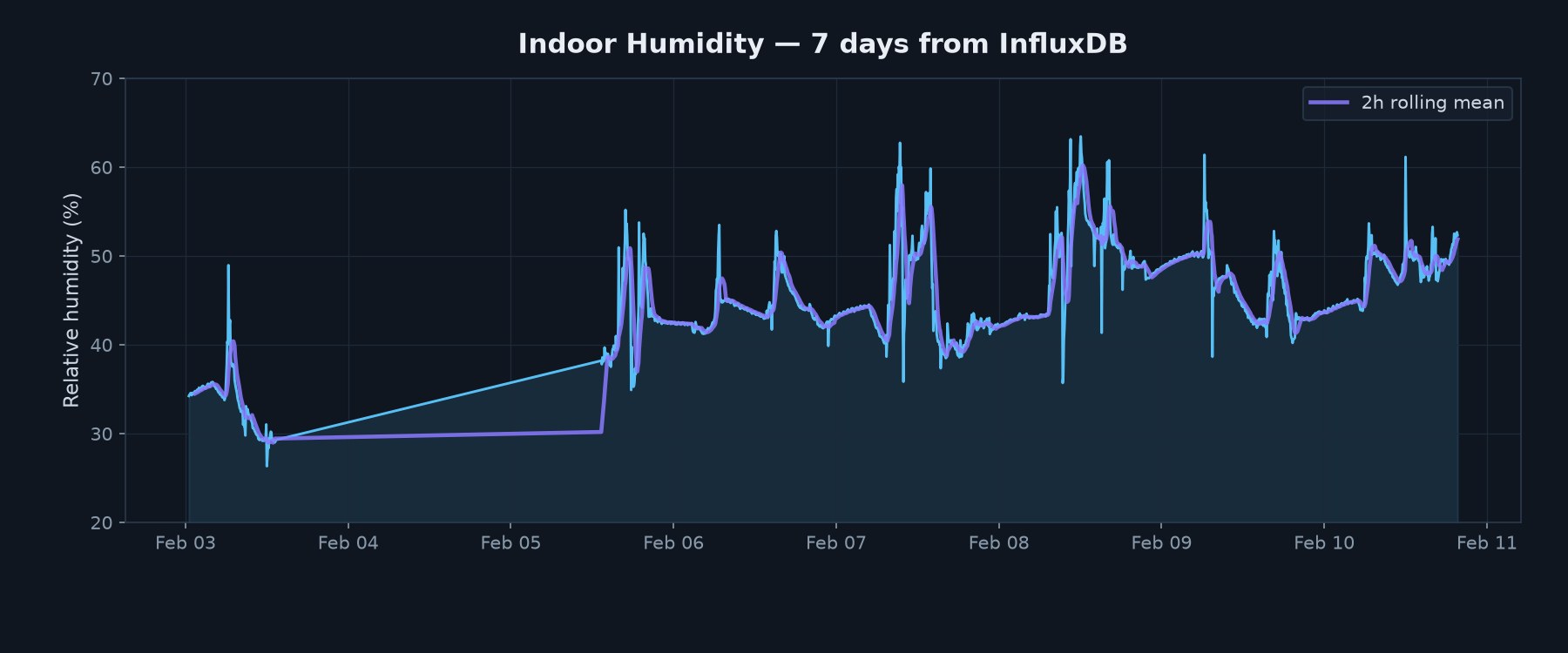
The time series this runs on
The chart below is real indoor humidity collected by the Enviro board over
months — the exact signal the model learns to predict. The dehumidifier’s
on/off state (the Shelly ison reading) is what the scheduler is trying to
optimize.
Architecture by component
1. Edge devices (hardware)
Two families of microcontrollers live in the rooms, plus a smart plug that both meters and switches the dehumidifier.
- Pimoroni Enviro (Indoor) — a Raspberry Pi Pico W running MicroPython.
Wakes every 10 minutes, takes temperature, humidity and gas-resistance
readings, and writes them straight to InfluxDB via the firmware’s
influxdbupload destination. It has its own captive-portal provisioning flow, NTP clock sync, cached-upload retry on WiFi failure and a USB-power temperature offset compensation. - ESP32 humidity gauge — a TFT display that renders an analog %RH dial by querying the humidity reading over HTTP, with deep-sleep wake on a button press. An early “always-visible” view of the same data.
- Shelly Plug S — a WiFi smart relay that powers the dehumidifier. It
exposes a tiny HTTP API (
/relay/0?turn=on|off,/status/0) that both Telegraf (for metering) and the backend (for control) call.
2. Collection & storage (env + data)
- Telegraf polls the Shelly’s
/status/0JSON endpoint every 30 minutes with aninputs.http+json_v2parser, extracting power, relayison, temperature, WiFi RSSI and firmware tags, then writes them to InfluxDB v2 (outputs.influxdb_v2, buckethome). - InfluxDB is the single time-series store. The Enviro writes its
readings directly; Telegraf writes the Shelly metrics. Everything is
queryable with Flux —
range,aggregateWindow(every: 1h, fn: mean)andpivotto turn fields into columns. - Backups —
influx_backup.shexports the bucket to CSV snapshots (data/influxdb_backup-*), which double as the offline training set for the notebooks. - SMHI — Sweden’s open weather API (
notebooks/SMHI.py) pulls outdoor temperature and humidity for the nearest station, joined into the training data so the model can reason about outdoor conditions.
3. Backend (control/backend)
A FastAPI service that owns the device model, the scheduler and the ML
runtime. Auth is an OAuth2 password flow with JWT; all /api/v1/* routes are
protected.
- DeviceManager — an abstract
Devicebase with two implementations:SwitchDevice(the Shelly plug —on/offactions via httpx, plus power, temperature andisonqueries) andSensorDevice(the Enviro — read-only,noopaction, exposes temperature/humidity/gas-resistance queries). Each measurement method delegates to a Flux query indatabase/influxdb.py, so the device classes are the single seam between the API and the time-series store. - DeviceScheduler — an
asyncioloop that fires at the top of every hour. For each schedule it reads the 24-elementhourly_schedule, takes the current hour’s action, and — if ML threshold mode is enabled for that hour — runs the model, compares its output toml_threshold_value, and picks theml_threshold_above_actionorml_threshold_below_action. The winning action is executed on the device and the resulting on/off state is recorded. Arun_now()lets the UI trigger an immediate evaluation after a schedule edit. - MLModelService — loads ONNX (
onnxruntime) or pickle (joblib) models from disk, caches them by id, and runs inference. For regressors it returns the raw predicted value (so the threshold comparison is meaningful); for classifiers it returns a boolean. It also computes SHAP explanations —TreeExplainerforHistGradientBoostingRegressor, falling back toKernelExplainer— so each decision is inspectable. - Input processors — a pluggable
InputProcessorbase (app/ml_processors/) turns raw device readings into model features. The built-inhumidity_modelprocessor resamples Shellyisonand Enviro humidity to hourly, builds lag features (humidity lags + relay-state lags) and cyclical sin/cos encodings of month and hour — exactly the feature recipe the notebook trains on. Custom processors are auto-discovered. - Persistence — SQLite holds the configuration (devices, schedules,
ml_models, device-state history); InfluxDB holds the measurements. The split keeps config fast and transactional while time-series stays in a purpose-built store.
4. Frontend (control/frontend)
A React (Create React App) SPA behind a login screen.
- Devices — list/detail with live sensor charts (temperature, humidity,
gas resistance, power,
ison) served by the/sensor-dataendpoints. - Schedules — a 24-hour grid editor where each hour gets an action, plus per-hour ML-threshold configuration (enabled hours, threshold value, and the above/below actions).
- ML Models — register a model (type, file path, input processor, input devices), and a Test button runs it against current device data and returns the output with the SHAP explanation.
- Status — a live system log view pulled from the backend’s log buffer.
5. The model (notebooks + models)
ftx-auto-model.ipynb is where the humidity predictor is trained and
exported:
- Loads the InfluxDB backup CSVs (Enviro + Shelly) and SMHI weather, resampled
to hourly with
isontaken as the hourly max. - Cleans the signal — FFT deseasonalization + an
IsolationForestto flag and drop temperature outliers, then interpolation. - Engineers features: lags of humidity and relay state, plus sin/cos encodings of month and hour.
- Trains a two-stage stack: a weather model
(
HistGradientBoostingRegressor) from SMHI + indoor sensors, then an FTX model that corrects the weather model’s residual using the dehumidifier’s on/off state — so it learns the effect of running the dehumidifier. - Evaluates with R²/MAPE on a time-series split, inspects with SHAP beeswarms,
and exports the final estimator with
joblibtomodels/humidity_prediction_model_*.pkl, which the backend’sMLModelServiceloads at runtime.
Technologies used
Edge hardware
- Pimoroni Enviro (Pico W, MicroPython)
- ESP32 + TFT_eSPI (humidity gauge)
- Shelly Plug S (relay + metering)
- Direct InfluxDB writes from firmware
- Captive-portal provisioning, NTP sync
Collection & storage
- Telegraf (inputs.http, json_v2)
- InfluxDB 2.x (bucket, Flux)
- SMHI open-data API (weather)
- influx_backup.sh → CSV snapshots
Backend
- FastAPI + Uvicorn
- asyncio hourly scheduler
- SQLite (devices, schedules, ml_models)
- httpx (Shelly control + metering)
- OAuth2 / JWT auth
- uv (package management)
ML & decisioning
- scikit-learn (HistGradientBoostingRegressor)
- SHAP (TreeExplainer / KernelExplainer)
- ONNX Runtime + joblib
- Pluggable InputProcessor feature pipeline
- Threshold-based on/off decisions
- Jupyter / pandas / plotly (training)
Frontend
- React (Create React App)
- React Router
- Devices, Schedules, ML Models, Status
- Sensor time-series charts
- 24-hour schedule grid editor
Operations
- Optional HTTPS (self-signed / Let's Encrypt)
- Configurable CORS origins
- File + buffer log streaming
- start.py / start.sh / start.bat launchers
Status: the full loop is live — Enviro sensors and Shelly plugs are ingesting into InfluxDB, the hourly scheduler runs a trained humidity regressor, and threshold decisions switch the dehumidifier automatically. The React dashboard manages devices, schedules and models, and SHAP explanations make every decision inspectable. Active work is on refining the feature pipeline and adding more ML deciders per schedule.